
Mat Pilates vs Reformer Pilates: Which Is Actually Better?

Updated: Mar 9

Every boutique studio in London seems to have a reformer machine right now. There's one near London Bridge. One on Borough High Street. One on Tooley Street. They're gleaming, photogenic, and — at £25–35 a session — they've built a convincing case that reformer Pilates is the real Pilates, and the mat version is just what you do when you can't afford the machine.
Here's the thing: that's a great marketing story. It's just not accurate.
As a Pilates studio in Southwark that offers mat-based classes, we're obviously not neutral on this — so we'll be upfront about that. What we can offer is an honest breakdown of what the research shows, what experience teaches, and what actually matters if you're trying to get stronger, move better, and feel good in your body.
What Is the Difference Between Mat and Reformer Pilates?
Both formats are rooted in the same method, developed by Joseph Pilates in the early 20th century. Both improve core strength, posture, flexibility and body awareness. The fundamental principles — control, breath, precision, centreing — are identical. What differs is the equipment.
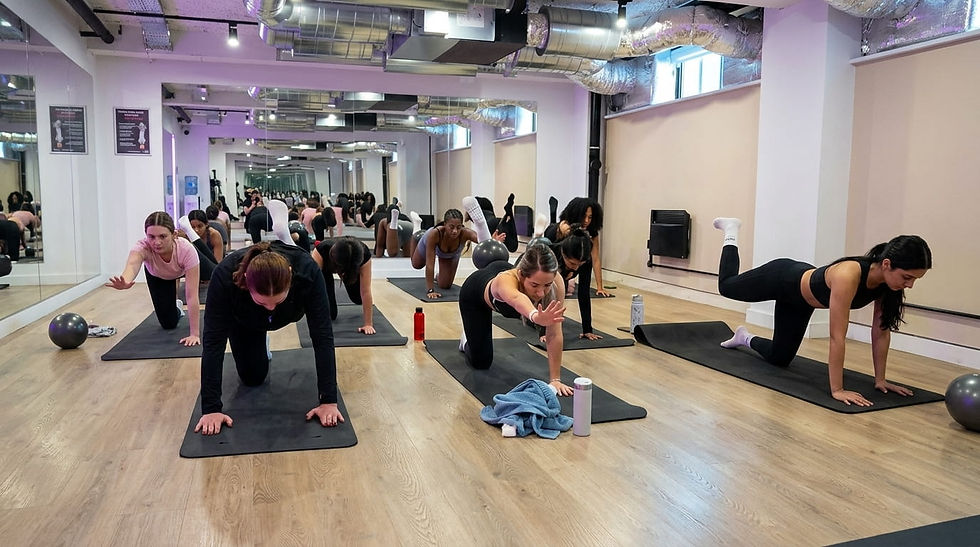
Mat Pilates uses your bodyweight as the primary source of resistance. You work on a mat with small props (resistance bands, a Pilates ball, light weights) when introduced. Every exercise requires your own muscular effort from start to finish. Nothing assists you.
Reformer Pilates uses a sliding carriage on a spring-loaded frame. Those springs can either resist or assist your movement, depending on how they're calibrated. That's the crucial detail — and the source of most of the confusion about which is harder.
The Reformer Advantage (And When It Actually Matters)
The reformer earns its reputation in specific contexts, and we're not here to pretend otherwise.
For rehabilitation, it's genuinely excellent. The spring assistance allows people recovering from injury — a knee replacement, a prolapsed disc, postpartum pelvic floor weakness — to work muscles that they couldn't safely load with full bodyweight. If you're working with a physiotherapist on a targeted recovery programme, reformer work can be precisely calibrated in a way the mat cannot match.
For advanced practitioners, the machine opens up a library of exercises — long box work, footbar variations, standing sequences — that simply don't have a mat equivalent.
And for people who find it difficult to feel the right muscles working, the feedback from the moving carriage can be clarifying. If one hip is compensating, the carriage tells you.
These are real advantages. They're just not advantages that most beginners or general fitness-seekers actually need.
Why Mat Pilates Is Harder Than It Looks — and More Effective Than You'd Think
This is the part the reformer studios don't put on their Instagram.
When the springs assist you into a position, they're doing some of the work. When nothing assists you, every millimetre of that movement is yours to earn. This is why experienced Pilates teachers will often tell you that a well-executed mat session is more demanding than a reformer class at the same notional level.
Joseph Pilates didn't design the mat as a gateway to the machine. He designed it as the foundation of the method. The reformer was a complement to mat work — not a replacement for it, and not a superior version of it.
Mat Pilates is also:
More transferable to real life. Bodyweight control is how you move every day — getting up from the floor, carrying shopping, sitting at a desk without your back protesting. Reformer strength doesn't translate as directly.
Easier to maintain independently. Once you've learned the exercises, you can practise at home with no equipment. That compounds your progress significantly.
More accessible at every level. Beginners aren't overwhelmed by the machine before they've learned the principles. Advanced students find nowhere to hide.

The Price Difference Is Not Small
Let's be honest about this, because it matters.
Reformer Pilates in London currently costs £20–35 per single class. Introductory offers — typically three classes for £55–75 — are designed to ease you into a monthly membership, which regularly runs £130–180 for unlimited classes.
If you do Pilates twice a week on a reformer, you're spending upwards of £200–250 per month.
At our Southwark studio, mat Pilates classes are £10 per session. Class packs and monthly memberships reduce that further.
For the same quality of movement, the same outcomes, taught by equally qualified instructors — it's worth asking whether the machine is worth the premium, or whether it's become a lifestyle signal as much as a fitness choice.
Mat vs Reformer — Side by Side
Mat Pilates | Reformer Pilates | |
Suitable for complete beginners | ✅ Ideal | ⚠️ Can be confusing at first |
Good for injury rehab | ⚠️ Depends on injury | ✅ Excellent |
Core strength | ✅ | ✅ |
Posture and alignment | ✅ | ✅ |
Flexibility | ✅ | ✅ |
Can practise at home | ✅ | ❌ |
Equipment required | Minimal | Machine (£3,000–8,000) |
Average class price in London | £8–12 | £22–35 |
Difficulty (honest answer) | High — no assistance | Variable — springs can assist |
So Which Should You Actually Choose?
If you're recovering from a specific injury and working with a physio, reformer sessions may be clinically appropriate — ask your practitioner.
If you're a healthy adult who wants to get stronger, improve posture, reduce back pain, move better and build a sustainable fitness habit — mat Pilates will get you there. For less money, with more flexibility, and arguably with more of the original method intact.
The best Pilates is the Pilates you'll actually do consistently.
A £10 class near London Bridge that fits into your lunch break beats an £180 monthly membership you feel guilty about not using.
New to Pilates entirely? Start with our beginner's guide to Pilates in Southwark.
Join Our Pilates Classes in Southwark
We offer Mat Pilates, Strong Pilates and Mama & Baby Pilates at our studio on Copperfield Street, SE1 — a short walk from London Bridge, Borough, Southwark and Waterloo East stations.
Small group classes mean you get individual attention. Qualified, experienced instructors mean you're learning it correctly. And at £10 per class, you can commit without the anxiety of a four-figure annual membership.
Frequently Asked Questions
Is mat Pilates suitable for complete beginners?
Yes — and in many ways it's the better starting point. Without a machine doing any of the work, you learn to control your own body from day one, which builds a more transferable foundation. Our Pilates classes in Southwark welcome absolute beginners every week.
How does mat Pilates compare to reformer for core strength?
Research shows comparable core strength outcomes between mat and reformer Pilates when classes are taught at an equivalent level. The difference is in how you get there, not in the destination.
How many times a week should I do mat Pilates?
Two to three sessions per week produce the clearest improvements in strength, posture and mobility. Once a week will maintain your fitness level. If you're just starting out, two sessions is a manageable and effective frequency.
Is mat Pilates good for back pain?
Yes — Pilates (mat and reformer) is widely recognised as effective for managing chronic lower back pain. A 2015 systematic review in the Journal of Orthopaedic & Sports Physical Therapy found that Pilates-based exercises offer superior pain relief for non-specific low back pain compared to minimal intervention.
Where can I do mat Pilates near London Bridge?
The London Academy of Dance offers mat Pilates classes in Southwark SE1, minutes from London Bridge and Borough Market. Drop-in classes from £10, with class pack and membership options available. Book online here.
What's the difference between mat Pilates and Strong Pilates?
Mat Pilates follows the classical Pilates method and focuses on precise, controlled movement using bodyweight. Strong Pilates incorporates resistance tools alongside Pilates principles for a more intensity-focused session — think of it as mat Pilates with added challenge. Both are available at our Southwark studio.


Comments