
What Makes a Good Pilates Class?

Pilates options have multiplied in recent years—from local gyms and community centres to online platforms—which is brilliant for accessibility.
But it also means the quality varies widely. A Pilates class at one studio can feel completely different from a class down the road, even if they're both called "Mat Pilates" and cost exactly the same.
If you're feeling a bit overwhelmed by the choices—whether you're a complete beginner worried about keeping up, or you're looking for a studio that finally feels like home—here's what actually makes the difference between a genuinely good class and one that just goes through the motions.

The Instructor
This is the single biggest factor by a mile.
A great Pilates instructor doesn't just stand at the front, demonstrate exercises, and count reps. They really watch you. They notice when your hips are tilting, when your shoulders are creeping up toward your ears, or when you're holding your breath. Most importantly, they correct you—gently, specifically, and without any judgment—so the movement finally makes sense.
What to look for:
Qualified and experienced. Pilates instructor qualifications vary enormously. Look for instructors with recognised certifications (STOTT, Body Control, Balanced Body, BASI) and ideally several years of teaching. Weekend certification courses exist, and the difference shows.
They cue with precision. "Engage your core" is vague. "Draw your lower belly in towards your spine without flattening your back" is specific. Good instructors give you cues you can actually follow.
They correct you. If an instructor never adjusts anyone, either the class is too big or they're not paying attention. Pilates without correction is just stretching with good intentions.
They adapt. Not everyone in the room has the same body, the same experience, or the same limitations. A good instructor offers modifications naturally — not as an afterthought, but as part of how they teach.
At TLAD, our Pilates instructors hold recognised qualifications and teach regularly enough that they know their regulars, notice changes, and build on what you did last week. That continuity matters more than people realise.
Class Size
This one's simple: the smaller the class, the more attention you get.
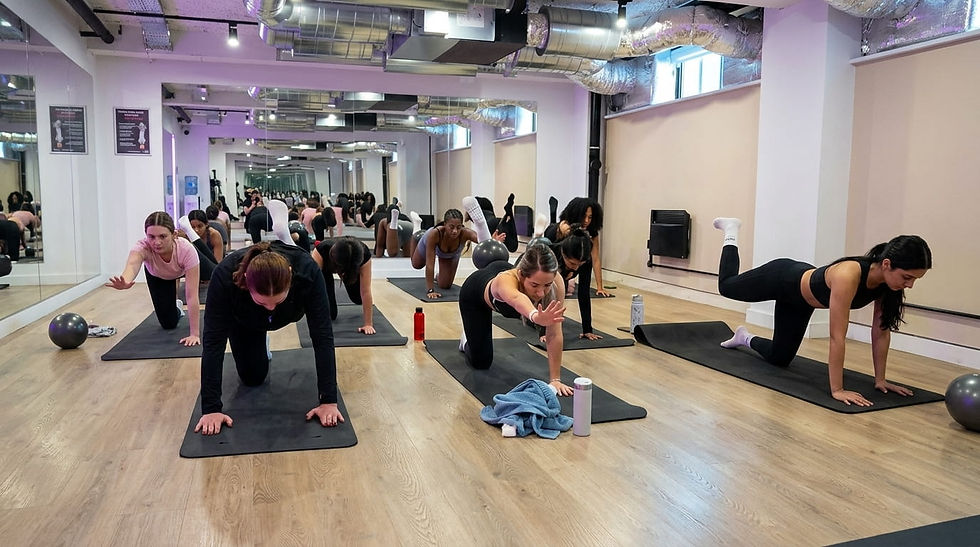
In a crowded class of 25 people, your instructor physically cannot watch everyone. It's easy to feel lost in the back row, and you might be doing an exercise incorrectly for weeks without knowing it—which is, at best, ineffective, and at worst, a route to injury.
What to look for:
Under 15 people is a good benchmark for group Mat Pilates. Under 10 is even better.
Can the instructor see you? If you're tucked in a corner behind three rows of mats, you're essentially doing a home workout with background music.
Our classes at TLAD are deliberately kept small - that's how we make sure every person in the room gets the benefit of being there.
The Studio Space
The environment matters more than people give it credit for. Pilates asks you to focus inward — to pay attention to small, precise movements. That's much harder in a noisy, cluttered, or overly bright space.

What to look for:
Clean and well-maintained. This sounds obvious, but worn-out mats, dusty equipment, and flickering lights tell you something about how much care goes into the space.
Temperature. A studio that's too hot or too cold makes concentration harder. Pilates isn't a sweat class — you want to be comfortable enough to focus.
Natural light, where possible. There's a real difference between practising in a room with windows and practising in a dark, fully enclosed room. It affects your mood, your energy, and how the session feels overall.
Not cramped. You need enough space to extend your arms and legs fully without worrying about hitting someone. If you're packed in elbow to elbow, the class is too full for the room.
Our studio on Copperfield Street has natural light, and enough space for everyone to move freely. It sounds like a small thing, but people notice the difference.
Equipment
For Mat Pilates, you don't need much — a good mat, perhaps a resistance band, a small ball, maybe a Pilates ring. But the quality of those basics matters.
What to look for:
Mats that are thick enough. Thin yoga mats on a hard floor make kneeling and lying exercises uncomfortable, which distracts from the work.
Props are clean and in good condition. Fraying resistance bands and deflated balls aren't just unpleasant — they change the effectiveness of the exercise.
For Strong Pilates or reformer classes: Is the equipment well-maintained? Do the springs feel right? Is there enough equipment for everyone without sharing or waiting?
At TLAD, we offer both Mat Pilates (classical, bodyweight-focused) and Strong Pilates (with added resistance — bands, weights, and rings). All equipment is provided and maintained.
The Music (or Lack of It)
This is more personal than the other factors, but it's worth thinking about.
Some Pilates classes use no music at all — just the instructor's voice and the sound of controlled breathing. Others use a carefully curated playlist that sets a calm, focused tone without being distracting.
Neither is wrong. But the wrong music can genuinely undermine a Pilates class. Loud pop playlists, jarring transitions between tracks, or music that's simply too fast for the movement — these things pull your attention outward when Pilates is asking you to go inward.
What to look for:
Does the music match the pace of the class? Slow, ambient, intentional — that's what works for most Pilates sessions.
Is it too loud? You should be able to hear your instructor clearly at all times.
Or would you prefer silence? Some people find music distracting in Pilates. A good studio will tell you what to expect before you book.
The Vibe
This is the hardest thing to describe and often the most important.
A truly great Pilates class has a certain feeling to it. You should feel focused, never stressed. The instructor should be warm and approachable—no question is ever silly. There should be absolutely no competitive energy; you are there for your own body, not to keep up with anyone else. You should feel welcome from the very second you walk through the door.
What to look for:
How are you greeted? Does someone acknowledge you when you arrive? Do they ask if it's your first time?
Is the pace right? A class that rushes through exercises is prioritising volume over quality. Pilates should feel measured and intentional.
Do you leave feeling better? Not just physically, but mentally. A good Pilates class leaves you feeling calmer, more connected to your body, and quietly accomplished. If you leave feeling anxious, rushed, or frustrated, something isn't right.
How to Know If a Pilates Class Is Right for You
You can read reviews. You can check qualifications. You can look at photos of the studio. And all of that helps.
But honestly? The only way to really know is to come and try.
Every studio has its own personality. Every instructor teaches slightly differently. The class that your colleague raves about might not suit you, and the one you nearly didn't book might become the highlight of your week.
Most good studios—including ours—let you book a single session without any membership or commitment. That's deliberate. We'd rather you come once, experience it properly, and decide for yourself than sign up for something based on a website.
Pilates at The London Academy of Dance
Mat Pilates: Multiple sessions per week—classical Pilates focused on core, posture, and flexibility. Perfect for all levels.
Strong Pilates: Weekdays—Pilates with added resistance for people who want a bit more intensity without losing the precision.
Pre-natal and Post-natal Pilates - special classes with pre/post natal qualified instructors to help you prepare for and recover after giving birth.
Small classes. Highly qualified instructors. A beautiful studio with natural light and space to breathe.
No membership required. No commitment. Just book one class and see how it feels.
Explore All Fitness Classes at TLAD and See Our Pilates Timetable.
📍 Copperfield Street, Southwark SE1 — 10 minutes from London Bridge, 5 minutes from Borough station.
Frequently Asked Questions
What qualifications should a Pilates instructor have?
Look for certifications from recognised bodies like STOTT Pilates, Body Control Pilates, BASI, or Balanced Body. These programmes require hundreds of hours of training and supervised practice. Weekend or online-only certifications exist but typically don't cover the depth needed to teach safely and effectively, particularly for clients with injuries or specific needs.
How big should a Pilates class be?
For group Mat Pilates, under 15 people is a good benchmark — under 10 is ideal. The smaller the class, the more your instructor can watch your form, offer corrections, and tailor modifications to your needs. If the class is too large, you lose the precision that makes Pilates effective.
What's the difference between Mat Pilates and Strong Pilates?
Mat Pilates uses your bodyweight as the primary resistance, focusing on core strength, flexibility, and controlled movement. Strong Pilates adds external resistance — bands, light weights, and Pilates rings — for people who want more physical challenge while maintaining the same focus on precision and form.
How do I know if a Pilates class is right for me?
The honest answer is to try one. Read reviews, check the instructor's qualifications, and look at the studio — but the feel of a class is something you can only experience in person. Most good studios let you book a single session without commitment so you can see for yourself.
Is Pilates good for back pain?
Pilates is widely recognised as one of the most effective forms of exercise for chronic lower back pain. It strengthens the deep core muscles that support your spine and improves how you move in daily life. Many GPs and physiotherapists recommend Pilates as part of a back pain management plan. If you have an acute injury, check with your healthcare provider before starting.


Can confirm Laura is absolutely amazing! For me the instructor and class vibe are two most important things. Took a while to find a MY pilates class, but i'm glad i found it here