top of page

BLOG

Search

There's a conversation that happens in Pilates studios in London. It usually goes something like this:


"I love Pilates, but I want something… more."


More intensity. More resistance. More of that satisfying, muscles-actually-worked feeling you get from a strength session — without giving up the control, the technique, and the focus on your body that makes Pilates worth doing in the first place.


That's what Strong Pilates is. It takes everything that works about mat Pilates — the core engagement, the precision, the emphasis on how you move rather than just how much — and adds resistance tools on top. Bands. Light weights. Pilates rings. The kind of equipment that turns a controlled exercise into a controlled exercise that also makes you sweat.


We run Strong Pilates four times a week at The London Academy of Dance in Southwark, and it's become one of our most popular classes. Here's what it actually involves, who it's for, and what to expect if you've never tried it.


Strong Pilates at the London Academy of Dance in Southwark

How Strong Pilates Differs from Regular Mat Pilates

If you've done mat Pilates, you already know the basics: controlled movements, core engagement, breathing with intention, working muscles through precise ranges of motion. Mat Pilates uses your bodyweight as resistance, and it's genuinely effective — especially for posture, core strength, and spinal health.


Strong Pilates keeps all of that. The same principles, the same attention to form, the same instructor watching you to make sure you're doing it right. What changes is the load.


By adding resistance bands, light dumbbells, and Pilates rings into the sequences, Strong Pilates asks your muscles to work harder through those same controlled movements. A glute bridge becomes a glute bridge with a resistance band around your thighs. A chest press becomes a chest press with light weights and a slow, controlled tempo that makes two kilograms feel like ten.


The difference in the room is noticeable. Mat Pilates is quiet, focused, almost meditative in its concentration. Strong Pilates has the same focus, but there's an edge to it — more effort, more visible exertion, more of that post-workout glow that tells you something happened.


The key thing: Strong Pilates doesn't sacrifice technique for intensity. You're not throwing weights around. Every movement is still deliberate, still controlled, still precise. The resistance is there to make the Pilates harder, not to turn it into something else.


Strong Pilates equipment at the London Academy of Dance in Southwark

How It Compares to Other Options

If you're weighing up where Strong Pilates fits, here's how it stacks up:


  • Strong Pilates vs Mat Pilates

Mat Pilates is the foundation. It builds core strength, improves posture, and teaches you how to move well using just your bodyweight. Strong Pilates takes those foundations and adds external resistance. Think of mat as learning the language, and Strong Pilates as having more complex conversations in it.


Choose mat if: you're new to Pilates, recovering from injury, or want a calmer, more restorative session. Choose Strong if: you already have the basics and want more physical challenge.


  • Strong Pilates vs Reformer Pilates

Reformer studios use a machine that provides resistance through springs. It's effective, but it costs £25-35 per class and locks you into a specific piece of equipment. Strong Pilates achieves a similar resistance effect using portable tools — bands, weights, rings — at a fraction of the cost. You're also building more functional strength because nothing is assisting your movement.


Choose a reformer if: you want machine-assisted resistance and don't mind the price point.

Choose Strong if: you want resistance-based Pilates without the reformer price tag, and you value functional, unassisted strength.


  • Strong Pilates vs HIIT

HIIT is fast, explosive, high-impact. It burns a lot of calories in a short time, but it's tough on joints and doesn't teach you much about how your body moves. Strong Pilates is slower, more controlled, and low-impact — but don't mistake that for easy. The resistance and the tempo create a deep muscular fatigue that HIIT doesn't reach.


Choose HIIT if: your primary goal is maximum calorie burn and you don't have joint issues.

Choose Strong Pilates if: you want strength that's built with control, your joints need protecting, or you've burned out on high-impact training.


If you're also considering Barre or Zumba, we recently put together a comparison of all three.


What a Typical Strong Pilates Class Looks Like

A class runs 45 minutes. Here's roughly how it breaks down:


Warm-up (5-10 minutes)

Breathing work and gentle mobilisation. This isn't filler — it prepares your deep stabilising muscles for the work ahead and gets your spine moving safely. You'll probably do some pelvic tilts, spinal articulation, and gentle core activation. If you've come from a desk, this alone will feel valuable.


Upper body block (10-12 minutes)

Working your arms, chest, shoulders, and upper back using light weights and resistance bands. The movements are small and controlled — think slow bicep curls with a pause at the top, chest presses at a tempo that makes your arms shake, and band pull-aparts that light up muscles between your shoulder blades you forgot existed.


Lower body block (10-12 minutes)

Glutes, thighs, and hamstrings. This is where the resistance bands earn their reputation. Banded bridges, clamshells, and leg press variations that build up a deep burn. The instructor will cue your form constantly — where your knees track, whether your pelvis is stable, how to avoid letting your lower back take over.


Core block (8-10 minutes)

The part where everything comes together. Planks with variations, dead bugs with weights, oblique work with the Pilates ring. Your core is already engaged from everything else, so this section feels like the finishing touch — intense but earned.


Cool-down and stretch (5 minutes)

Controlled stretching to release the muscles you've just worked. Hip flexors, chest, hamstrings, spine. You'll leave feeling genuinely longer.


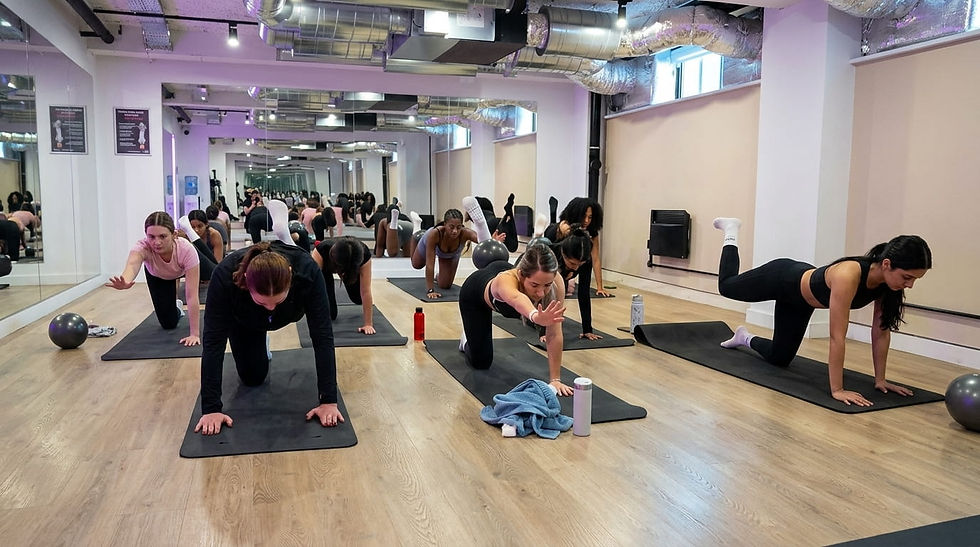
Strong Pilates class at the London Academy of Dance in Southwark

Who Strong Pilates Is For

Strong Pilates fills a gap that a lot of people don't realise exists until they try it. It's for:


  • People who find mat Pilates "not enough." You've been doing regular Pilates for a while. You love the method but you want more intensity. Strong Pilates gives you that without abandoning what makes Pilates effective.

  • Gym-goers who want something different. You know how to lift. You understand resistance. But you've never worked with the kind of slow, controlled tempo that Pilates demands — and it challenges your muscles in ways that fast reps don't.

  • Desk workers with problem areas. If your shoulders are permanently tense, your back hurts by 3pm, and your hip flexors are concrete, Strong Pilates addresses all of that through strengthening the muscles that counteract sitting — with enough resistance to make a real difference. I'll find our lunchtime classes particularly helpful and impactful if you are sitting at your desk all day.

  • People who want results without impact. Bad knees, dodgy ankles, joints that protest when you run or jump — Strong Pilates gives you a genuine strength workout without any of that. Every movement is controlled and low-impact.

  • Anyone who's burned out on HIIT. You did the high-intensity thing. It worked for a while. Then your body started objecting, or you just stopped wanting to do it. Strong Pilates is challenging in a completely different way — slower, more deliberate, and easier to sustain long-term.


What Changes and When

Based on what we see with people attending Strong Pilates twice a week:


Weeks 1-2:

You'll feel it. Muscles you didn't know you had will make themselves known, especially through your core, glutes, and the backs of your arms. You'll also start learning the tempo — the slow, controlled speed that makes the resistance tools effective.


Weeks 3-4:

Your posture starts shifting. You'll sit taller without thinking about it. Standing feels different. The exercises that made you shake in week one start feeling manageable — which means it's time to increase your resistance band or pick up slightly heavier weights.


Weeks 6-8:

Visible changes. Your arms look more defined. Your waist feels firmer. The muscles in your legs have more shape. People who lift weights alongside Strong Pilates often notice their fitness form improving — Pilates teaches you to engage muscles more efficiently.


Weeks 10-12:

This is where people tend to say "my body feels different." Not just how it looks, but how it works. Fewer aches. Better balance. More strength in daily life — carrying shopping, picking up children, sitting through a long day without pain.


The Practical Stuff

When: Strong Pilates runs four times a week at TLAD:

  • Wednesday at 12PM

  • Thursday at 7:30AM and 12PM

  • Saturday at 11:15AM

Check the timetable for the latest schedule.


Where: The London Academy of Dance, Copperfield Street, Southwark SE1 — five minutes' walk from London Bridge, Borough, and Southwark stations.


Cost: From £10 per class. No membership needed. Pay per session or grab a class pack.


What to bring: Comfortable workout clothes, a water bottle, and a towel if you like. All equipment (mats, bands, weights, rings) is provided.


Do I need Pilates experience? It helps but isn't essential. If you've never done any Pilates, starting with a few mat sessions first will help you understand the fundamentals — breathing, core engagement, neutral spine. But if you're reasonably active and comfortable following instructions, you can jump straight in. Our instructor adapts exercises throughout, so you'll be working at your level.


Who teaches it? Meet our instructors on the team page.


Ready to Try Strong Pilates?

The best way to find out if it's for you is to try a single class. No commitment, no membership, no pressure. Book a session, turn up, work hard, and see how your body feels the next day.


If you've been doing mat Pilates and want more — or if you've been doing everything else and want something smarter — this is it.


FAQ


Is Strong Pilates harder than regular Pilates?

Yes — the added resistance makes it more physically demanding. But "harder" doesn't mean "not for beginners." The resistance level is adjustable (lighter bands, smaller weights), and the instructor offers modifications throughout. It's harder in the way that makes you stronger, not the way that makes you dread coming back.


Do I need Pilates experience before trying Strong Pilates?

It helps but isn't required. If you've done a few regular Pilates classes and understand the basics — breathing, core engagement, neutral spine — you'll feel more comfortable. If you're active and good at following cues, you can start with Strong Pilates directly. Let the instructor know it's your first time and they'll keep an eye on your form.


What equipment is used in Strong Pilates?

Resistance bands, light dumbbells (typically 1-3kg), and Pilates rings. All equipment is provided — you just need to show up in workout clothes. The tools are used to add load to familiar Pilates movements, not to create a completely different workout.


How many calories does Strong Pilates burn?

Roughly 250-400 calories per 45-minute session, depending on the intensity of your resistance and your body composition. That's more than standard mat Pilates (200-350) but less than high-intensity cardio like Zumba (400-600). The real benefit is in building lean muscle, which increases your resting metabolic rate — meaning you burn more calories throughout the day, not just during class.


Can I do Strong Pilates if I have back pain?

In many cases, yes — Pilates-based exercise is widely recommended for back pain management. However, Strong Pilates involves more resistance than standard mat work, so let your instructor know about your back pain before class. They'll modify exercises to keep you safe while still giving you a good workout. If your pain is acute or post-surgical, start with regular mat Pilates and progress to Strong once your instructor advises it.

You've decided to try a fitness class. Good. That was the hard part.


Now comes the surprisingly tricky bit: choosing which one.


Zumba, Barre, and Pilates are three of the most popular group fitness classes in London right now, and if you've been reading about them online, you've probably ended up more confused than when you started. Every article says they're all amazing. Every studio says theirs is the best. None of them tells you which one will actually suit you.


We teach all three at The London Academy of Dance in Southwark, so we don't have a favourite. What we do have is an honest take on what each class feels like, what it's good for, and who tends to love it — based on watching hundreds of people try all three.


Zumba vs Pilates vs Barre comparison — colourful Zumba trainers, mat Pilates core work, and Barre grip socks at The London Academy of Dance studio in Southwark

The Quick Comparison


Zumba

Pilates

Barre

Best for

Cardio, mood, fun

Core strength, posture, flexibility

Toning, balance, sculpting

Intensity

Medium-high (cardio)

Low-medium (controlled)

Medium (endurance burn)

Calories/class

400–600

200–350

300–450

Coordination needed?

Some (but no one cares)

Minimal

Minimal

Impact on joints

Low

Very low

Very low

Vibe

Party, music, energy

Focused, calm, precise

Structured, burn, satisfying

How you feel after

Buzzing, energised, sweaty

Longer, looser, quietly worked

Shaky legs, strong, accomplished

Best if you hate

Boring cardio

High-impact workouts

Repetitive gym exercises

If this table is enough for you to decide, go ahead and book a class. If you want the full picture, keep reading.


Zumba: The One That Doesn't Feel Like Exercise

Zumba class at the London Academy of Dance, near Waterloo, London Bridge and Southwark

Let's get the obvious thing out of the way: Zumba is a workout disguised as a party. You'll move to Latin, Afrobeat, pop, and whatever else your instructor throws at you. You'll sweat. You'll probably laugh. You'll likely lip sync. And forty-five minutes will pass before you think about checking the clock.


That last part is the real selling point. Most people who hate exercise hate it because it's boring, repetitive, and feels like a punishment. Zumba is none of those things. It's the reason people who've abandoned gyms, running programmes, and home workout apps keep showing up week after week.


What actually happens in a Zumba class:

You follow the instructor through choreographed sequences set to music. There's no stopping to count reps. No equipment. If you get a move wrong (you probably will), nobody notices because everyone's too busy getting their own moves wrong. You feel like a star of your own music video. The instructor keeps it moving, the energy carries you, and by the end, you've done a full cardio workout without ever having to convince yourself to keep going.


What Zumba is good for:

  • Cardiovascular fitness — your heart rate stays elevated the whole class

  • Burning calories — 400 to 600 in 45 minutes, depending on how much you commit

  • Mental health — dance-based exercise has been shown to reduce cortisol and boost endorphins more than repetitive gym workouts

  • Social connection — Zumba classes have a group energy that treadmills don't


What Zumba is not:

Zumba won't build significant muscle or dramatically change your posture. If your goal is toning, core strength, or rehabilitation, Pilates or Barre will serve you better. Zumba is about cardio, energy, and making fitness fun and something you look forward to.


Who loves Zumba:

People who like to dance - in your kitchen, lift, on your break, while taking a shower or anywhere else - you will love a Zumba class. People who've tried everything else and given up. People who want a workout that's social and fun. People who like music and don't mind moving to it — even badly. People who don't like the feel of gyms.


At TLAD, we run Zumba classes in Southwark on Sundays at 11AM. No dance background needed. Just trainers, water, and willingness to move.

Pilates: The One That Changes How Your Body Works

Pilates class at TLAD, near Southwark, London Bridge and Waterloo

Pilates is the opposite energy to Zumba. Where Zumba is loud and freeform, Pilates is quiet and precise. You'll work muscles you didn't know you had, in ways that feel weirdly hard for movements that look weirdly gentle.


The thing most people don't realise about Pilates until they try it:

it's not easy. It looks calm from the outside, but five minutes into a class, when your instructor asks you to hold a position and breathe into exactly the right part of your ribcage while keeping your pelvis neutral, you'll understand why people who've been doing it for years still find it challenging.


That precision is also why it works. Pilates builds strength from the inside out — starting with the deep stabilising muscles that support your spine, your posture, and the way you move through daily life. It's the reason physios recommend it. It's why people with desk jobs and chronic back pain keep coming back.


What Pilates is good for:

  • Core strength — the real, deep kind, not just surface-level ab workouts

  • Posture — most people notice a difference within 3-4 weeks

  • Back pain — widely recognised as one of the most effective approaches for chronic lower back issues

  • Flexibility and mobility — without the intensity of yoga

  • Rehabilitation and injury prevention


Mat Pilates vs Strong Pilates:

At TLAD, we offer both. Mat Pilates uses your bodyweight and is the classical foundation — demanding in ways that sneak up on you. Strong Pilates adds resistance tools (bands, weights, rings) for people who want more intensity. It sits somewhere between traditional Pilates and a strength training class. If you've been doing mat Pilates for a while and want more challenge, or if you come from a gym background and find mat Pilates too slow, Strong Pilates is worth trying.


We've written a detailed mat Pilates vs reformer Pilates comparison if you're weighing up your options across London studios.


Who loves Pilates:

Desk workers with bad backs. People returning from injury. New mums rebuilding core strength. Anyone who wants results that go deeper than aesthetics — better movement, less pain, a body that functions well.


TLAD runs Pilates classes in Southwark multiple times per week — including early morning, lunchtime, and dedicated prenatal and postnatal sessions.

Barre: The One That Makes Your Legs Shake

Barre class at the London Academy of Dance in Southwark

Barre borrows from ballet but you don't need to be a dancer to do it. You'll use a ballet barre (or a chair) for balance while you work through small, controlled movements — tiny pulses, isometric holds, and repetitions that target very specific muscles until they start trembling.


The trembling is actually the point. Barre works by fatiguing muscles through high repetitions of small movements, which builds lean strength and muscular endurance without bulk. It's precise, structured, and produces a very specific kind of satisfying soreness the next day.


What actually happens in a Barre class:

You'll work through sections — usually arms, thighs, glutes, and core — with the barre as your anchor. The movements look small but feel surprisingly intense. Your instructor will offer modifications throughout, so you can increase or decrease the challenge. Most classes run 45 minutes to an hour and end with a stretch sequence.


What Barre is good for:

  • Toning and sculpting — especially legs, glutes, and arms

  • Balance and stability

  • Muscular endurance — holding positions builds a different kind of strength than lifting heavy

  • Low-impact on joints — no jumping, no pounding

  • Flexibility — the stretch component is genuine, not an afterthought


How Barre compares to Pilates:

People ask us this constantly, and we've written a full comparison of Barre vs Pilates. The short version: Pilates focuses on core stability and controlled full-body movement. Barre focuses on isolating and fatiguing specific muscle groups. Pilates will change how your body moves. Barre will change how your body looks. Many people do both.


Who loves Barre:

People who like structure and precision in their workouts. Runners and cyclists who want to balance their training. Anyone who finds gym machines boring but wants visible toning results. Former dancers and people curious about ballet-inspired movement.


Barre classes at TLAD run on Thursdays and Fridays in Southwark. No ballet experience necessary.

So Which One Should You Try?

Forget about which one is "best." They're different tools for different goals. The right one is whichever aligns with what you actually want.


Choose Zumba if:

  • You want cardio that doesn't bore you

  • You've tried gyms and hated them

  • You want something social and fun

  • You care more about how you feel

  • You want to burn calories without thinking about it


Choose Pilates if:

  • You want to fix your posture or back pain

  • You want deep core strength

  • You're returning to exercise after injury or pregnancy

  • You want something low-impact but genuinely challenging

  • You like precision and controlled movement


Choose Barre if:

  • You want visible toning, especially in legs and glutes

  • You like structured, targeted workouts

  • You want low-impact exercise that still makes you sore

  • You appreciate ballet aesthetics without the ballet pressure

  • You want to complement running, cycling, or other cardio


Choose more than one if:

Honestly, the best results come from combining them. Zumba for cardio. Pilates for core and mobility. Barre for toning. They complement each other in ways that repeating the same class three times a week doesn't. Our timetable is designed so you can mix classes throughout the week.


The Practical Stuff

Where: The London Academy of Dance, Copperfield Street, Southwark SE1 — 5 minutes from London Bridge, Borough, and Southwark stations.


Cost: Classes from £8. No membership required. Buy a single class or a class pack.


What to wear: Comfortable workout clothes. Trainers for Zumba. Socks or bare feet for Pilates and Barre.


Booking: View the fitness timetable and book online. Walk-ins welcome when space allows, but booking guarantees your spot.


First time? Every class welcomes beginners. Our instructors modify exercises throughout, so you'll be working at your level from day one.


FAQ

Is Zumba, Barre, or Pilates better for weight loss?

Zumba burns the most calories per session (400–600) thanks to sustained cardio. But weight loss depends on consistency — the best class for weight loss is whichever one you'll actually attend every week. Pilates and Barre also contribute through building lean muscle, which increases your resting metabolic rate over time.


Can I do Zumba, Barre, and Pilates in the same week?

Yes — they complement each other well. Zumba covers cardio, Pilates strengthens your core and improves mobility, and Barre targets toning and muscular endurance. Combining them gives you a more balanced fitness routine than repeating any single class.


Which is best for beginners with no fitness experience?

All three welcome beginners, but Zumba is the easiest to jump into — there's no right or wrong, and the music carries you along. Pilates and Barre require more body awareness but every class offers modifications for new participants.


Is Barre or Pilates better for toning?

Barre is more targeted for visible toning, especially in the legs, glutes, and arms. Pilates builds deeper core strength and improves posture, which changes your overall body shape over time. Many people do both for the best results.


Do I need dance experience for Zumba?

No. Zumba is designed for people without dance backgrounds. You follow the instructor and move to the music. Coordination helps but isn't essential — half the fun is getting things gloriously wrong.


How often should I attend classes to see results?

Two to three times per week is the sweet spot for most people. You'll notice improvements in energy and mood within the first two weeks, posture changes within four weeks, and visible body changes within eight to twelve weeks of consistent attendance.

Fitness classes at TLAD in Southwark

There's something about the middle of the day that makes your body want to move. You've been sitting for hours, your shoulders have crept up towards your ears, and your back is starting to remind you that chairs weren't really designed for humans.


What if, instead of eating lunch at your desk and scrolling on your phone, you spent 40 minutes doing something that left you feeling genuinely good? Lighter, more focused, and physically reset for the afternoon ahead.


That's what our lunchtime fitness classes are for. At The London Academy of Dance in Southwark, we run Pilates and Barre classes right in the middle of the day — designed for people who work nearby and want to move their bodies without it taking over their schedule.


Why lunchtime fitness works so well

There's real science behind the midday workout. A study published in the Journal of Occupational Health Psychology found that employees who exercised during the workday reported better mood, higher energy levels, and improved concentration in the afternoon — compared to days they didn't move at all.


And it makes sense when you think about it. By midday, your energy naturally dips. A coffee pushes through it temporarily. Movement actually recharges it. You come back to your desk with clearer thinking, less tension in your body, and — this is the part people don't expect — you're usually more productive in the afternoon, not less.


The other thing worth saying: it doesn't have to be intense. Some of the most effective lunchtime classes are the ones where you move slowly, with control. That's exactly what Pilates and Barre offer.


Your lunchtime class options

We run three types of classes during the middle of the day, each one a little different. Here's what they are and who they tend to suit best.


  1. Mat Pilates — Tuesdays at 12PM

Mat Pilates class at the London Academy of Dance in Southwark

Mat Pilates is the one to try if you want something focused and restorative. It's all about controlled movement — strengthening your core, improving your posture, and building flexibility without any impact on your joints.


If you spend your mornings hunched over a laptop, this class is going to feel like exactly what your body's been asking for. The movements are slow and precise. You'll feel your muscles working, but you won't be dripping in sweat — which makes it practical for getting back to work afterwards.


Good for: anyone who wants to build core strength, improve posture, or ease tension from desk work. No experience needed.


Want to understand the difference between mat-based and reformer Pilates? We wrote a full comparison: Mat Pilates vs Reformer Pilates.


  1. Strong Pilates — Wednesdays & Thursdays at 12PM

Strong Pilates class at the London Academy of Dance in Southwark

Strong Pilates takes the same principles as Mat Pilates — alignment, core, control — and adds more resistance and intensity. You'll use your bodyweight in challenging ways, and you'll feel your muscles shake in the best possible way.


This is for you if you want Pilates with an edge. It's still low-impact, so your joints are safe, but the pace is quicker and the movements are more dynamic. It's a proper workout that fits into 40 minutes. You'll leave feeling strong and energised — not wiped out.


Good for: anyone who likes a challenge, wants to build visible strength, and has some fitness experience (though beginners are always welcome).


  1. Barre — Thursdays at 12:45PM

Barre class at the London Academy of Dance

Barre is a ballet-inspired fitness class built around small, precise movements — tiny pulses, isometric holds, and controlled lifts that target muscles you probably didn't know you had. Especially your glutes, thighs, and core.


Don't worry — you don't need any dance experience. Barre is about technique and control, not choreography. The movements are small, but the burn is real. Most people are pleasantly surprised by how much they feel it the next day.


It's also excellent for posture. If your shoulders round forward at your desk or your lower back aches by 3 PM, Barre strengthens exactly the muscles that counteract those patterns.


Good for: toning, balance, flexibility, and anyone who wants to feel long, lean, and strong. Not sure whether Barre or Pilates is right for you? Here's our honest breakdown: Barre vs Pilates.


The practical stuff

We know that fitting a class into your workday only works if the logistics make sense. Here's the quick version:


How long are the classes? 40-45 minutes. Short enough to fit into a lunch break, long enough to make a real difference.


Do you have showers? Yes. Our studio has showers and changing facilities, so you can freshen up before heading back to the office. We also provide mats and any equipment you'll need — just bring yourself, something comfortable to wear, and a water bottle.


Where are you? 📍 Copperfield Street, Southwark, London SE1. We're a short walk from:


  • London Bridge — about 8 minutes on foot

  • Borough — about 5 minutes

  • Southwark — about 7 minutes

  • Waterloo East — about 10 minutes


Do I need experience? Not at all. Every class welcomes beginners. Our instructors offer modifications so you can work at your own level, and they'll make sure you feel comfortable from your first session.


Do I need a membership? No. You can book a single class with no membership and no contract. We also offer class packs if you'd like to come regularly — but there's no commitment required. Just try one and see how you feel.


How Pilates and Barre help with desk-related tension

If you work at a desk, your body develops patterns over time. Your hip flexors shorten from sitting. Your upper back rounds forward. Your core switches off because there's nothing asking it to work. And your neck and shoulders carry tension from hours of screen time.


The NHS recommends regular exercise as one of the most effective ways to manage back pain, improve posture, and reduce the physical effects of a sedentary lifestyle. Both Pilates and Barre address these patterns directly:


  • Pilates strengthens your core and teaches your body better alignment — so you sit taller and move more freely

  • Barre targets the postural muscles in your back, glutes, and legs — building the strength that keeps you upright without thinking about it

  • Both improve flexibility and help release the tension that accumulates from sitting


You don't need to come every day. Even one class a week can make a noticeable difference to how your body feels — especially if you pair it with some simple stretches at your desk throughout the week.


Meet the team

Our fitness instructors are qualified, experienced, and genuinely warm. They know their regulars by name, they notice when something isn't quite right, and they adapt every class so it works for everyone in the room — from first-timers to people who've been coming for months.


That's one of the benefits of small group classes. You're not lost in a crowd. You're in a room with a handful of other people, an instructor who's paying attention, and an atmosphere that feels encouraging rather than intimidating.


Ready to try a lunchtime class?

If you work near London Bridge, Borough, or Waterloo and you've been thinking about adding some movement to your week — this might be the easiest way to start.


Here's how:

  1. Browse our fitness classes and see which lunchtime class catches your eye

  2. Book a single class — no membership, no contract, no commitment

  3. Wear something comfortable, bring a water bottle, and give yourself permission to take a proper break. Your body will thank you — and honestly, so will your afternoon.


We'll see you at the studio. 🧘‍♀️

Frequently Asked Questions

What lunchtime fitness classes do you offer?

We offer Mat Pilates (Tuesdays at 12PM), Strong Pilates (Wednesdays and Thursdays at 12PM), and Barre (Thursdays at 12:45PM) — all at our studio on Copperfield Street, Southwark SE1.


How long are the classes?

All our lunchtime classes are 40-45 minutes, designed to fit comfortably into a lunch break with time to change and freshen up.


Do you have showers and changing facilities?

Yes. We have showers and changing areas, and we provide mats and equipment. Just bring comfortable clothes and a water bottle.


How close are you to London Bridge?

About an 8-minute walk. We're also 5 minutes from Borough station, 7 minutes from Southwark, and 10 minutes from Waterloo East.


Do I need fitness experience?

Not at all. Every class welcomes complete beginners. Our instructors offer modifications so you can work at your own level.


Can I just come to one class without a membership?

Yes. You can book a single class with no membership and no commitment. Class packs are also available if you'd like to attend regularly.


Is Pilates or Barre better for back pain?

Both can help. Pilates strengthens your core and improves alignment, which supports your lower back. Barre strengthens the postural muscles in your back and glutes. If you're unsure which to try first, read our comparison: Barre vs Pilates.

bottom of page