
Barre for Beginners: What No One Tells You Before Your First Class

You might have heard about Barre. Maybe you've seen it on a timetable, walked past a studio, or had a friend mention it. You're curious — but not sure what it actually involves, or whether it's right for you.
Here's a clear guide to what Barre is, what your first class will feel like, and why the thing that surprises most beginners (the shaking) is a sign you're doing it exactly right.

What is Barre?
Barre is a low-impact fitness class that takes inspiration from ballet, Pilates and yoga. The name comes from the ballet barre — the horizontal rail attached to the wall, used for balance during exercises. You don't need any dance experience. Most people in a Barre class have never danced in their life.
The movements are small, precise and controlled. You'll work muscles you didn't know you had, in positions that feel new at first and familiar within a few sessions. It's strength work, but without heavy weights. It's cardio, but gentle on your joints. It's flexibility work, but not a stretch class.
The combination of all three is what makes it effective — and why so many people keep coming back.
What actually happens in a Barre class?
A typical class at TLAD runs 60 minutes and follows a consistent structure. Once you've done it once, the format will feel familiar.
Warm-up (5–10 minutes): Light movement — arm circles, small jumps, direction changes. Just enough to warm the body and get you present.
Barre / Balance work (25–30 minutes): This is the core of the class. You'll stand at the barre (or use a chair) and move through a series of small, precise exercises: pliés (a gentle bend of the knees), relevés (rising onto the balls of your feet), leg lifts and hip work. The movements are small. The effort is not.
This is where the shaking happens — more on that below.
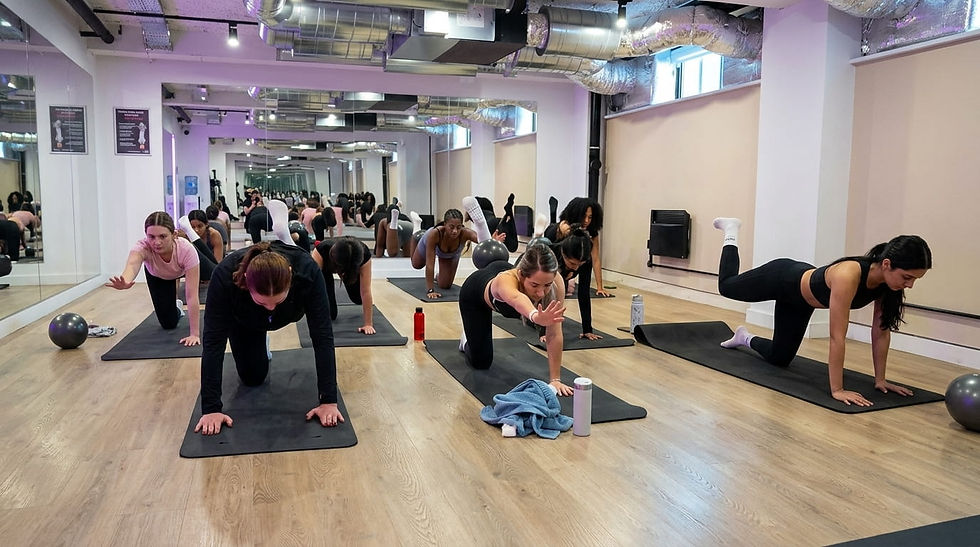
Floor work (10–15 minutes): You'll move to the mat for core work, glute exercises and inner thigh exercises. Slow, controlled movements, similar in feel to Pilates.
Stretch (5 minutes): A full cool-down to finish. After holding so many small positions, the stretch at the end feels very welcome.
If you have any injury or joint concern, let your instructor know before class. Barre is gentle on the joints, and modifications are always available.
Why do my legs shake in Barre? Is that normal?
Yes — and it's actually a good sign.
The shaking happens when your muscles get tired and start working harder to hold a position. It means you've found the right range of motion and the muscles are fully engaged. People who've been doing Barre for a while actively look for that feeling in class — it's how you know the work is happening.
The first time it happens, it can feel surprising. By the third or fourth session, it starts to feel like progress.
If you're shaking, you're doing it right.
Do I need any dance experience?
Not at all. Most people in a Barre class have no dance background.
The ballet inspiration shows in the style and positions of the movements — the posture, the precision, the attention to alignment — but you're not learning choreography. Your instructor will guide you through everything verbally. Barre is a fitness class, not a dance lesson.
If you can stand at a barre and follow instructions, you can do Barre.
What should I wear?
Comfortable leggings and a fitted top work best — your instructor needs to see your alignment to guide you well.
For footwear, you can come barefoot or wear grip socks. Grip socks (the ones with small rubber dots on the sole) are popular because they make the floor sections more comfortable. You can pick up a pair online for a few pounds, or just come barefoot to your first class and see how you find it.
We provide everything else.
How is Barre different from Pilates?
The two are often mentioned together, and they do have things in common — both are low impact, both focus on controlled movement and core strength, both tend to attract people who want something more mindful than a gym session.
But they feel quite different. Pilates is mostly floor-based and focuses on spinal movement, core activation and controlled breathing. Barre is more upright and built around standing lower-body work with a ballet-inspired structure.
The simplest way to choose: if you want core and flexibility work on a mat, try Pilates. If you want standing leg and glute work with a ballet feel, try Barre. Lots of people at TLAD do both — they work well together.
Here's a full comparison of Barre vs Pilates if you'd like to read more.
How many sessions before I see results?
You'll feel it after one class — your glutes and inner thighs will let you know.
Visible changes — better posture, stronger legs, a more toned waist — tend to show after four to six consistent sessions. Posture usually improves first, because Barre works the muscles that hold you upright. People around you often notice before you do.
Barre rewards consistency. It keeps getting more challenging as you get stronger, which is why people stick with it long-term. Once a week is a good starting point. Many regulars build up to two or three sessions a week once they've settled into it.
One thing people often ask: will Barre make my legs bulky? No. The style of movement — many repetitions with little resistance — builds lean strength and tone, not muscle bulk.
Is Barre good for weight loss?
A 45-minute Barre class burns roughly 250–400 calories, depending on how hard you work. It's not primarily a cardio class, but it does burn energy and build lean muscle — and more muscle means your body uses more energy throughout the day.
People who do Barre regularly tend to look and feel different even when the number on the scales stays the same, because they're building muscle and reducing fat at the same time.
If burning more calories per session is your goal, combining Barre with Zumba or Strong Pilates gives you the best of both.
Where and when at TLAD
Barre classes run at The London Academy of Dance, Copperfield Street, London SE1 0EA. We're a short walk from Borough Market and London Bridge station.
Classes run on weekday mornings and lunchtimes. You can book a single class with no membership needed. See the full timetable for current times.


Comments