
Mama & Baby Pilates: What to Expect at Your First Class

Having a baby changes everything — including how you exercise. Your body feels different. Your schedule is unpredictable. And the idea of leaving your baby at home, or finding childcare just to get to a fitness class, adds a layer of logistics that nobody has energy for in those early months.
Mama & Baby Pilates exists for exactly this reason. Your baby comes with you. The class is built around where you are right now — not where you were before pregnancy, and not where you'll be in a year.
If you've been thinking about coming but aren't sure what to expect, here's exactly what happens.

What is Mama & Baby Pilates?
It's a Pilates class designed specifically for new mums — with their babies in the room.
Unlike regular Pilates, the pace is gentler, the focus is on rebuilding deep core strength safely, and nobody minds if your baby has opinions about the timing of a certain exercise. Babies are on the mat beside you, incorporated into some movements, and lovingly included in the class.
It's one of three postnatal offers at TLAD, each with a different feel. Strong Mama is postnatal Pilates without babies — better suited once your little one is in childcare and you want to push harder. Mama & Baby Dance Fitness brings babies into a dance-based session rather than a Pilates one. This class sits between them: Pilates principles, baby on the mat beside you.
When can I start after giving birth?
The general guidance is:
Vaginal birth: from around 6–8 weeks, once you've had your postnatal check
C-section: from around 10–12 weeks, with GP clearance
Always check with your GP or midwife before returning to any exercise class. If they've given you the go-ahead for gentle exercise, Mama & Baby Pilates is a good place to start.
Check out our helpful guide on returning to exercise after pregnancy for more details on how to return to fitness safely.
What do I need to bring?
Baby: obviously 😉. In a car seat, carrier, pram, Moses basket — whatever works for where they are that day
Water: for you, and whatever your baby needs
A change of baby kit: just in case
Your own snacks: if you're breastfeeding, bring something — you'll thank yourself
You don't need to have done Pilates before. You don't need to have been active during pregnancy. Come as you are. We provide all the equipment, including mats. But some prefer to bring their own, either way works.
What does the class actually look like?
Here's roughly how the 40 minutes go:
Arrival (first 5 minutes before the class): Get settled, lay your baby down, say hello. There's no pressure to be ready the second you walk in. This isn't that kind of class.
Breathing and check-in (5–10 minutes): The class starts with breathwork and a gentle reconnection to your core. This isn't a warm-up in the traditional sense — it's teaching your body to communicate with itself again.
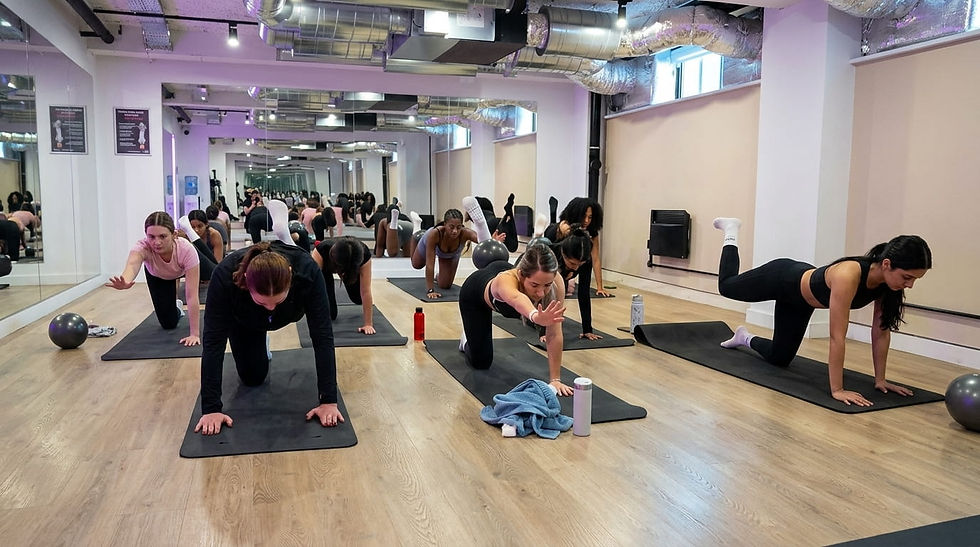
The work (20–25 minutes): A mix of floor-based Pilates movements — pelvic tilts, bridges, modified planks, side-lying leg work, seated core exercises. Everything is adapted for postpartum bodies. If something doesn't feel right, your instructor will offer a modification.
Baby interaction (woven throughout): Some movements use your baby as gentle resistance — overhead lifts, supported holds. This is optional and depends on your baby's mood. If they're asleep on the mat, that's absolutely fine too.
Cool down and stretch (5–10 minutes): A longer stretch than you'd normally get in a fitness class, because your body needs it.
After class: People tend to stay and chat. It's one of the better parts.
What if my baby cries?
They probably will at some point. So will someone else's. Nobody is going to judge you, your instructor won't skip a beat, and you absolutely don't need to leave the room.
This class is designed around the reality of having a baby — not around an idealised version of it. Feeding, changing, comforting — all expected, all fine, all part of the class.
Why Pilates specifically for new mums?
New mums often feel like they need to get back to cardio, running, or the gym as quickly as possible. The instinct makes sense. But your body has just done something extraordinary, and the foundation matters more than the speed of return.
Pilates addresses the specific things that change during and after pregnancy:
Pelvic floor: weakened by pregnancy and birth, and the most important thing to rehabilitate first
Diastasis recti: the separation of abdominal muscles that affects most women during pregnancy — Pilates is one of the safest ways to address this
Posture: your centre of gravity shifted during pregnancy, then changed again when you started feeding and carrying your baby. The back, shoulders and neck carry all of that
Core stability: the foundation for everything else you'll want to do eventually
Getting this right early makes everything else — running, gym, HIIT, whatever you want to return to — safer and more effective later.
Where and when at TLAD
Mama & Baby Pilates runs every Tuesday at 10:30AM at The London Academy of Dance, Copperfield Street, London SE1 0EA. We're a short walk from Borough Market, London Bridge station, and Elephant & Castle. If you're coming from Bermondsey or Waterloo, we're easy to reach.
Classes are pay-as-you-go — no membership, no commitment.
Interested in other prenatal and postnatal classes?
See our full Pre & Postnatal offer, including Prenatal Pilates and Strong Mama.


Comments