
Pilates for Office Workers in London Bridge: Easing Back, Hip and Shoulder Tension

If you work in or around London Bridge, chances are your day involves a lot of sitting. Screens, meetings, commuting, more screens. By mid-afternoon, your lower back aches, your shoulders are creeping towards your ears, and your hips feel like they've forgotten they're meant to move.
This isn't a fitness problem. It's a sitting problem. And Pilates is one of the most effective things you can do about it — not because it's trendy, but because it specifically targets the muscle imbalances that desk work creates.
This is a guide for people who work nearby and want something practical, regular, and effective — without needing to turn their life upside down to make it happen.

What sitting all day actually does to your body
This isn't about guilt-tripping you for having an office job. It's about understanding the physical reality, because once you understand the pattern, Pilates makes much more sense as a response.
Your hip flexors shorten. When you sit for hours, the muscles at the front of your hips stay in a shortened position. Over time, they tighten — which tilts your pelvis forward and puts compressive load on your lower back. This is one of the most common causes of lower back pain in desk workers, and it has nothing to do with your spine being "bad."
Your glutes switch off. Sitting puts your glutes on standby. They're not firing, not supporting your pelvis, not stabilising your lower body. When you then try to walk, run, or exercise, other muscles — often your lower back or hamstrings — compensate. That's when strains happen.
Your upper back rounds. The thoracic spine (mid-back) curves forward as you reach toward a screen. Your chest tightens, your shoulders round in, and the muscles between your shoulder blades weaken. Over months, this becomes your default posture — not just when sitting, but when standing and walking too.
Your neck and shoulders carry tension. Screen work drives your head forward and your shoulders up. The muscles at the base of your skull and across the top of your shoulders (the upper trapezius) hold chronic low-grade tension. This is why so many desk workers experience headaches, neck stiffness, and that persistent knot between the shoulder blades.
Why Pilates is specifically well-suited for desk workers
There are many forms of exercise that are good for you. Pilates is particularly well-matched to the problems of sitting because it works in the exact opposite direction to what your desk does to you.
It lengthens what sitting shortens. Hip flexor stretches, spinal extension, chest opening — these are core components of a Pilates class. You're systematically reversing the position you've been in all day.
It activates what sitting deactivates. Glute engagement, deep core activation, posterior chain strengthening — Pilates directly targets the muscles that go dormant during desk hours.
It improves posture from the inside out. Pilates doesn't just tell you to "sit up straighter." It strengthens the muscles that make good posture sustainable — so it becomes your default, not something you have to consciously force.
It's low-impact but not low-effort. You won't leave dripping in sweat (though you might in Strong Pilates). But you will feel muscles you didn't know you had. The controlled nature of the movements means it's safe for people with existing back or neck issues — provided the instructor knows what they're doing.
What a Pilates class actually targets (and how it helps your desk body)
Here's what a typical session works through and why each element matters if you spend your days sitting:
Core activation.
Not crunches — deep transverse abdominis and pelvic floor engagement. This supports your lumbar spine directly and reduces the load on your lower back. If you sit for eight hours, this is the muscle group that protects you.
Spinal mobility.
Rotation, flexion, extension — moving the spine through its full range. Desk workers often lose thoracic rotation, which affects everything from breathing to shoulder function. Pilates restores it systematically.
Hip opening.
Stretching the hip flexors, activating the glutes, mobilising the hip joint. After a week of desk work, this alone is worth the class.
Shoulder stability.
Strengthening the muscles that hold the shoulder blades in place — the lower trapezius and serratus anterior. This counteracts the forward-shoulder posture that screen work drives.
Breathwork.
Pilates breathing is diaphragmatic and coordinated with movement. For someone who's been shallow-breathing at a desk all day, this has a genuine calming, restorative effect that goes beyond the physical.
Lunchtime, morning, or evening: making it work around your schedule
One of the most common reasons office workers don't start a regular class is scheduling. Here's the reality: if you work near London Bridge, you're already close.
Our studio is at Copperfield Street, Southwark SE1 — roughly a 10-minute walk from London Bridge station and close to Borough Market. We run Pilates classes across the week including morning, lunchtime, and weekend slots.
Check the full fitness timetable for what fits your week. If you're looking for a lunchtime option specifically, our guide to lunchtime fitness near London Bridge has more detail.
A few practical notes:
- Sessions are typically 45–55 minutes — short enough to fit into a lunch break or before-work slot
- No membership required. Book a single class and see how it feels
- We provide mats. Just bring water and clothes you can move in
- If you've never done Pilates, that's fine — all classes welcome beginners
Which Pilates format is right for you?
We run two Pilates formats, and both are suitable for desk workers:
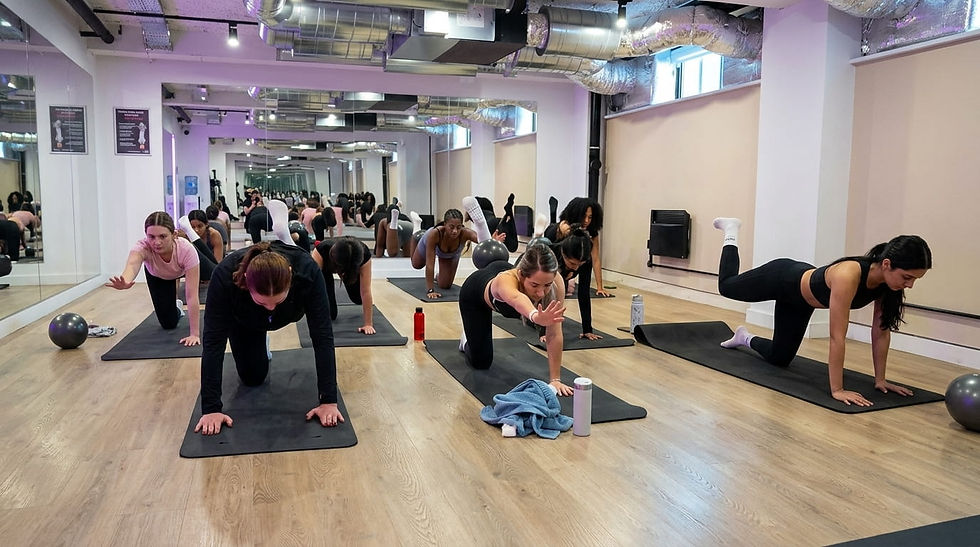
Mat Pilates— the classic. Bodyweight only, focused on control, alignment, and deep core work. This is the gentler entry point and excellent if you're coming from zero exercise or have existing back issues.
Strong Pilates — Pilates meets resistance training. More intensity, more muscle activation, still controlled. This suits desk workers who want to build functional strength alongside flexibility — particularly if your goal is to feel genuinely strong, not just stretched.
Both formats address the sitting-related issues outlined above. Mat Pilates is the better starting point if you're cautious; Strong Pilates if you want more challenge from the outset.
Frequently Asked Questions
Is Pilates good for lower back pain from sitting?
Yes. Pilates is one of the most commonly recommended forms of exercise for lower back pain, including by the NHS. It strengthens the deep core muscles that support the lumbar spine and stretches the hip flexors that often contribute to back discomfort in desk workers.
Can I do Pilates if I've never exercised before?
Absolutely. Pilates is designed to be accessible from the very beginning. Every exercise has modifications, and instructors guide you through form and breathing from your first session. Many of our members started with no exercise background at all.
How often should I do Pilates to see results?
Once a week is a realistic starting point and will produce noticeable improvements in posture and tension within three to four weeks. Twice a week accelerates those changes. Our guide on how long Pilates takes to show results goes into more detail.
Is Pilates better than yoga for desk workers?
Both are beneficial. Pilates tends to focus more on core strength, spinal alignment, and controlled movement — which maps closely to the specific issues desk work creates. Yoga tends to emphasise flexibility and mindfulness more broadly. For targeted relief of sitting-related tension, Pilates has a slight edge.


Comments