
What Does Barre Actually Do to Your Body? Changes You'll Notice After a Month

Barre is everywhere right now. Your friends are doing it. Your favourite influencer swears by it. The studios are full. And if you've been watching from the outside wondering whether it's actually worth the hype — or just another fitness trend that'll fade by next year — that's a fair question.

Barre has been around for decades. It was developed in the 1950s by a ballerina recovering from a back injury, and it's built on principles that don't go out of fashion — alignment, control, and precision. The reason it's having a moment right now isn't because it's new. It's because people are discovering what dancers have always known: training your body with grace and intention changes how you look, how you move, and how you feel in ways that a gym never quite manages.
At The London Academy of Dance in Southwark, we teach Barre every week. And we see this same progression play out with every new person who walks through the door. Here's what actually happens — week by week — when you start.
What makes Barre different from everything else
Before we get into the changes, it's worth understanding why Barre produces results that feel so distinct.
Barre is inspired by ballet — one of the most demanding, graceful, and structured movement forms in the world. Ballet dancers are strong, but they don't look like bodybuilders. They're precise, but they move with ease. They have extraordinary posture, long lean muscles, and a way of carrying themselves that looks effortless even though it's built on years of discipline.
Barre takes those principles — the positions, the alignment, the emphasis on control — and makes them accessible to anyone. You don't need dance experience. You don't need flexibility. You don't need to know what a plié is before you walk in. What you get is a way of training your body that brings something into your life that most fitness classes simply don't: grace.
Not in a performative way. In a practical way. The way you stand up from your desk. The way you walk through a room. The way your body feels when everything is aligned and working as it should. That's what Barre does. It's a fitness class, but the results go beyond fitness.
Week 1: Your body wakes up
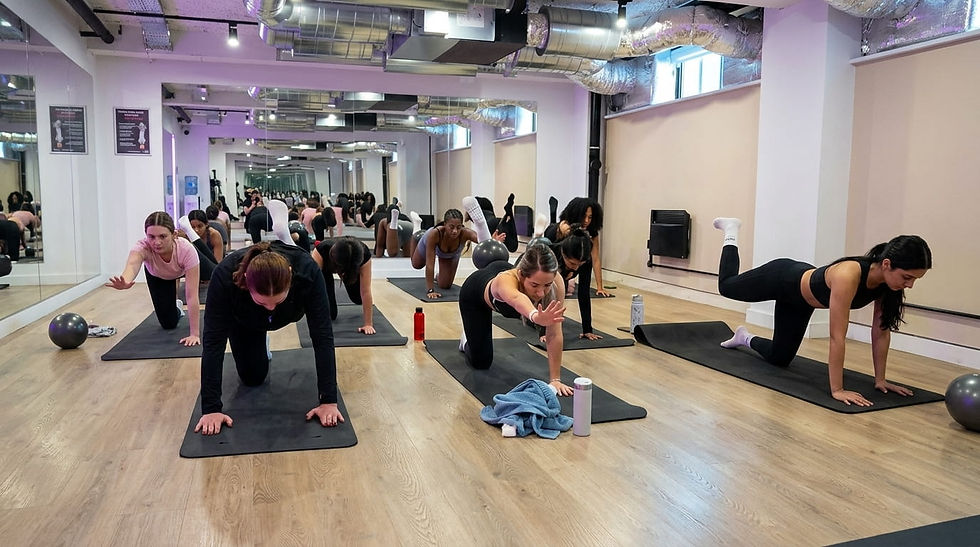
Your first Barre class will surprise you. The movements look small — tiny pulses, gentle lifts, isometric holds — but your muscles will shake. That's normal. It means they're working in a way they haven't been asked to before.
Most people feel it in their thighs and glutes first. That deep, satisfying burn that tells you something is happening, even though you're barely moving. You'll also notice muscles in your feet and ankles engaging — muscles that have been switched off by years of flat shoes and sitting.
After your first class, you might feel a pleasant soreness the next day. Not the kind that stops you walking — more like a reminder that your body did something meaningful.
If you've never tried Barre before, we wrote a full guide on what to expect at your first class
Weeks 2–3: Posture shifts first
This is the change people notice before anything else — and it often catches them off guard because they weren't looking for it.
Barre strengthens the muscles along your spine, between your shoulder blades, and through your core. These are the muscles responsible for holding you upright without you thinking about it. When they're weak (which they usually are if you sit at a desk), your upper back rounds forward, your shoulders creep up, and your lower back takes the strain.
After two or three classes, something shifts. You catch yourself sitting taller. Your shoulders drop away from your ears. Your chest opens. You feel longer — like someone has gently pulled you upward from the crown of your head. It's subtle, but it's real. And other people start to notice it before you do.
There's a reason ballet dancers carry themselves the way they do. That posture isn't genetic — it's trained. Barre gives you the same training, in a fraction of the time, without ever asking you to perform.
This is also why Barre works so well alongside Pilates. Pilates builds deep core stability. Barre strengthens the postural muscles around it. Together, they completely change how you carry yourself.
Weeks 3–4: Muscle tone becomes visible
This is the part most people are waiting for — and it's worth understanding why Barre produces a specific kind of tone that looks and feels different from what you'd get at a gym.
Barre works through high repetitions of small, controlled movements. Instead of lifting heavy weights for a few reps, you're holding positions and pulsing through tiny ranges of motion — sometimes for two or three minutes at a time. This targets slow-twitch muscle fibres, which are responsible for endurance and lean definition.
The result is muscles that look long and defined rather than bulky. You'll see it first in your legs and glutes — they become firmer and more sculpted. Then in your arms and shoulders. Your waist starts to look more defined, not because you've lost weight necessarily, but because your core is engaged and your posture is pulling everything into alignment.
It's a different kind of strong. You won't look like you've been lifting in a gym. You'll look like you've been dancing — which, in a way, you have.
The feeling people don't expect from Barre
We could fill this entire post with the physical changes, but the thing our members mention most often isn't their legs or their posture. It's how Barre makes them feel.
People come to Barre for the body. They stay for the head.
There's something about the combination of music, precise movement, and total concentration that clears your mind in a way few other workouts do. You can't think about your inbox when you're holding a relevé and pulsing for the twentieth time. Your brain has no choice but to be here, in this moment, in this movement.
That clarity follows you out of the studio. People describe it as feeling lighter — not just physically, but mentally. Less cluttered. More present. Like you've pressed a reset button on your nervous system. An hour of Barre and you walk out feeling longer, calmer, and more put together than when you walked in.
It's the ballet influence again. Ballet isn't just physical training — it's a practice of attention and intention. Barre inherits that quality. Every movement is deliberate. Every position has purpose. And that discipline, even in small doses, spills over into the rest of your day.
Barre vs Pilates vs gym: Why the results feel different
If you're deciding between Barre, Pilates, and the gym, it helps to understand what each one actually does differently. We wrote a detailed comparison of Barre, Pilates, and other fitness classes, but here's the short version:
Gym / weight training builds maximum strength and muscle size. You lift heavy, rest between sets, and progressively increase the load. The results are visible muscle mass and raw power. Great if that's your goal — but it doesn't do much for flexibility, posture, or the way you move through everyday life.
Pilates focuses on deep core strength, alignment, and controlled movement. It's excellent for back pain, rehabilitation, and building a foundation of stability. The results are internal at first — better posture, less pain, improved movement quality — before they become visible.
Barre targets the muscles between the big ones. The stabilisers, the postural muscles, the ones that create shape and definition. It draws from ballet to produce something unique: a body that's strong but graceful, toned but not bulky. And a posture that looks effortless even though it's earned. It also produces a mental clarity that's closer to yoga than to a gym session.
Most of our members do a combination. Barre and Pilates complement each other particularly well — the core stability from Pilates makes your Barre work more effective, and the muscle endurance from Barre makes your Pilates transitions smoother.
"But I'm not a dancer"
You don't need to be. Not even slightly.
Barre borrows from ballet technique — the positions, the precision, the emphasis on alignment — but it's not a dance class. You won't be learning choreography. You won't need coordination. You'll hold onto a barre (or a chair, or a wall) and move through structured exercises that your instructor guides you through step by step.
Here's the thing though: even without any dance experience, Barre brings a quality of ballet into your life. Not the performance. Not the tutus. The discipline, the grace, and the way it teaches your body to move with purpose. After a few weeks, you'll notice it — the way you stand, the way you walk, the way you sit. There's an elegance to it that other workouts simply don't offer.
If you can stand, you can do Barre. Everything has a modification. Your instructor will offer alternatives for every exercise, and nobody in the room cares what your version looks like. They're too busy concentrating on their own muscles shaking.
What you'll need
Nothing complicated:
Wear: Leggings and a fitted top (you need to be able to see your alignment). Socks with grip are ideal, but bare feet work too.
Bring: A water bottle. We provide mats and any equipment you'll need.
Know: There are showers and changing facilities at the studio if you're coming from work or heading somewhere after.
Try Barre this week
Our Barre class runs every Thursday at 12 PM at our studio on Copperfield Street, Southwark SE1. It's a beautiful way to spend your lunch break — 45 minutes of focused, precise movement to hit a little pause button while the rest of the world gets loud.
No membership required. No experience needed. Just book a single class and see how it feels.
📍 Copperfield Street, Southwark SE1 — 8 minutes from London Bridge, 5 minutes from Borough.
Frequently Asked Questions
How quickly will I see results from Barre?
Most people notice postural changes within two to three classes — you'll stand taller, feel longer, and your shoulders will drop into a more natural position. Visible muscle tone typically appears after three to four weeks of consistent practice — one to two classes per week. The mental benefits (clarity, calm, feeling lighter) often show up from the very first session.
Is Barre enough exercise on its own?
It can be, depending on your goals. Barre builds strength, improves flexibility, and enhances balance and posture. If you're looking for cardiovascular fitness as well, pairing Barre with something like Zumba or brisk walking rounds out the picture. Many of our members combine Barre with Pilates for a complete strength and flexibility programme.
Will Barre make me bulky?
No. Barre works through high repetitions of small movements, which targets lean muscle fibres rather than the fibres responsible for muscle bulk. The result is a toned, defined look — long, lean muscles rather than visible mass. The ballet influence is part of why: ballet training has always been about creating strength without size, and Barre inherits that principle.
How is Barre different from Pilates?
Pilates focuses primarily on deep core strength, spinal alignment, and controlled movement — often performed lying down on a mat. Barre is performed standing, using a ballet barre for balance, and targets the legs, glutes, and postural muscles through small, repetitive movements. Both improve posture and flexibility, but Barre emphasises muscular endurance and definition while Pilates emphasises stability and alignment. They complement each other well.
Do I need dance experience for Barre?
Not at all. Barre borrows technique from ballet — the positions, the precision — but it is not a dance class. There is no choreography to learn. Your instructor guides you through every movement, and every exercise has modifications for different levels. That said, you'll find that the ballet influence gives Barre a quality that other fitness classes don't — a sense of grace and intention that stays with you after you leave the studio.


Comments